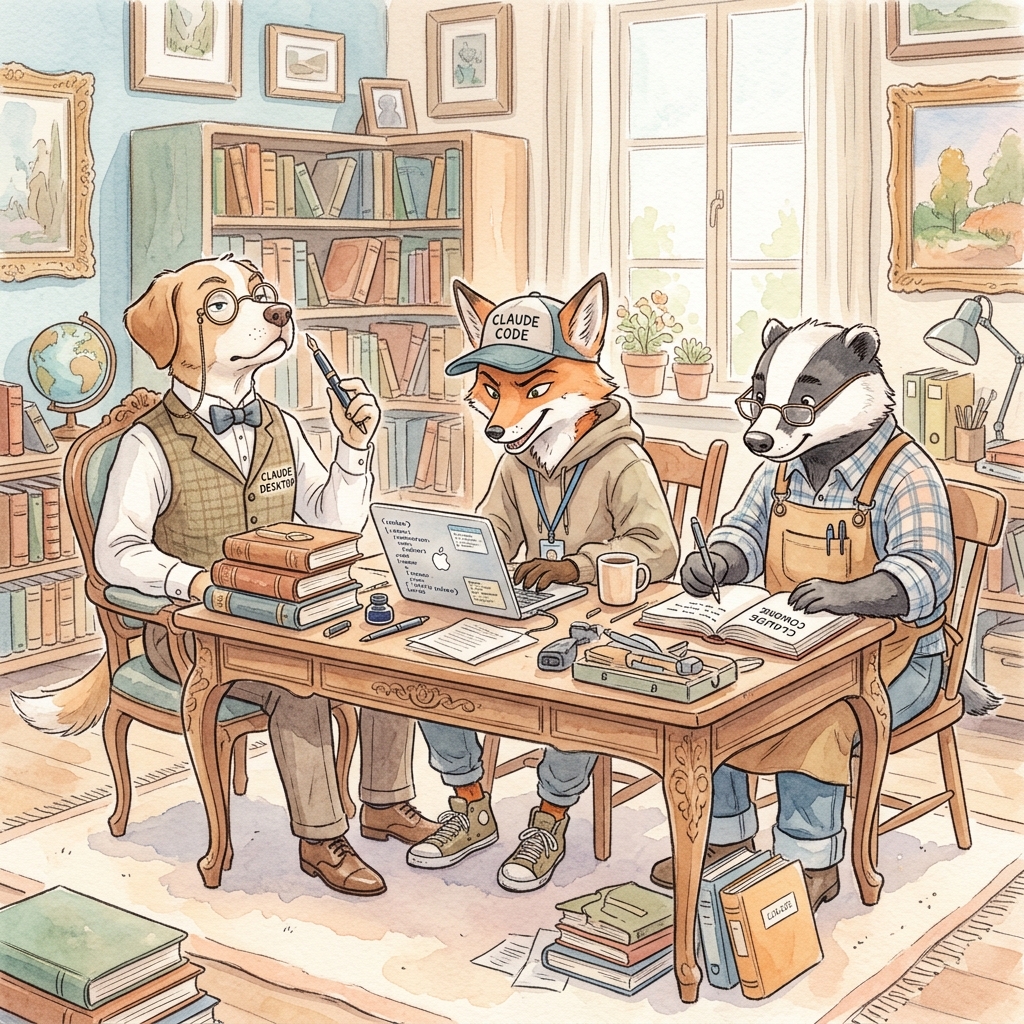
Claw Claw Clawdius: Same Brain, Different Bodies
They all run Opus 4.6. Same model weights, same training, same knowledge cutoff. And yet Claude Desktop, Claude Cowork, and Claude Code behave like three different beings.
I noticed this working across several projects recently — IdeasAhead, my poetry blog, the OpenClaw setup, a few others. I'd be in Desktop drafting an approach, switch to Code to build it, and the shift in how Claude responded was jarring. Not wrong. Just different. Like the same person in a meeting room versus at a workbench.
The harness — the UI, the tools available, the interaction pattern — shapes the AI's effective personality more than the model weights do. That's worth sitting with.
The I, Claudius Problem
The title is a stretch, I know. But the analogy works. Claudius — stammering, underestimated, written off by everyone in the imperial family — turned out to be the most capable emperor of the lot. Claude Code is like that. Terminal interface, no pretty UI, looks like you've regressed to the 1990s. And it's the most capable harness for actually building things.
Three Claudes, briefly: Desktop is the conversationalist. Cowork is the collaborator. Code is the builder. Same brain, radically different bodies.
Desktop — The Philosopher at the Whiteboard
Desktop Claude is spacious. You can think with it. Long conversations about architecture, trade-offs, "what should we even build here?" It's genuinely good at this — reasoning through problems, analysing documents, drafting prose, explaining complex ideas back to you in a way that sharpens your own thinking.
But it can't touch anything. No filesystem, no git, no real tool use beyond what's in the chat window. It's a brilliant colleague who can only talk. You finish a great conversation about what to build, and then you have to go build it yourself. Or switch to a different Claude.
I use Desktop for early-stage thinking. Content drafts. Research synthesis. The "what are we doing and why" conversations. It's the whiteboard session.
Cowork — The Pair Programmer Who Can Only See One File
Cowork added artifacts — real-time editing of documents and code, side by side with the conversation. A step toward actual collaboration. You can iterate on a specific thing together: polish a document, refine a code snippet, work through a design.
But each artifact is an island. No filesystem awareness, no project context. It can polish a gem but can't see the setting. You hand it a function, it'll improve it beautifully. Ask it about the three files that function depends on, and it doesn't know they exist.
I use Cowork for "let's get this one thing right" work. Iterating on a specific document or piece of code. It's the pair programming session where your partner can only see your screen, not the repo.
Code — Clawdius Himself
Claude Code lives in the terminal. It reads and writes files, runs commands, understands project structure through CLAUDE.md files, maintains session context, creates commits and PRs. It's the one that can actually do things.
The personality shift is real. Code-Claude is more direct, more action-oriented, more opinionated. When you can act, you do act. Desktop-Claude will discuss five approaches and help you weigh trade-offs. Code-Claude will discuss two, pick one, and start building. Sometimes it'll fix things you didn't ask it to fix — the "let me just clean this up too" problem. Mildly annoying, but it comes from the same place as its effectiveness.
The limitations are real too. You need to be comfortable with the terminal. There's no visual UI for artifacts. And that eagerness to act means you need to be clear about scope, or it'll refactor your entire codebase while you wanted a one-line fix.
I use Code for anything that involves actual building. Features, bug fixes, refactoring, infrastructure, deployment. It's where the work happens.
The Container Shapes the Contained
There's a deeper thing here that goes beyond product comparison.
In Sri Aurobindo's framework, there's the concept of adhara — the vessel or container that gives form to consciousness. The same underlying force, expressing through different instruments, produces different capabilities. The physical sheath, the vital sheath, the mental sheath — each one shapes what can manifest through it.
The model weights are the consciousness. The harness is the adhara. Change the vessel, change the expression.
This isn't unique to AI. Your tools shape your thinking. A developer in vim thinks differently from a developer in a visual IDE. Not better or worse — differently. The constraints and affordances of the instrument channel what's possible. A pianist and a guitarist might have the same musical understanding, but what comes out of their fingers is shaped by what's under them.
Most people pick an AI tool and assume they're getting "Claude." They're getting a Claude. One of several, each with different capabilities and blindspots.
Which Claw When
From experience, concretely:
Thinking and planning — Desktop. Give it the messy problem, let the conversation wander, get clarity.
Polishing a specific piece — Cowork. Hand it the thing, iterate together, get it right.
Building anything real — Code. This is where the work lives.
The actual skill isn't mastering one of these. It's fluency across all three. Knowing when to switch harnesses is like knowing when to move between whiteboard, pair-programming, and solo deep work. Each mode serves a different phase of the work.
Close
"Same model" is technically true and practically misleading. You're not choosing a model. You're choosing a relationship — a particular way of working together, with particular constraints and affordances.
Claudius outlasted them all. Not despite his limitations but through a different kind of intelligence that those limitations forced into being. The terminal is ugly, the UI is absent, the learning curve is real. But Clawdius gets things done.
I know which one I reach for most. You probably already know too.